Films and family (finally!)

There are surely many relevant films out there addressing issues of global concern, humanity, et cetera. As promised, here is a list of films that I recommend; I use them in my Global Psychology class. Don’t worry if you’re not into psychology…they are not psychology films per se (though all of them are relevant as they deal with the human condition). If you read about them online and find you’d like to watch any, I have them on DVD and you’re welcome to borrow them.

Beat the Drum (HIV/AIDS in South Africa)
Beyond our Differences (humanity’s connection through faith)
Cry, The Beloved Country (Apartheid; read the novel first)
Dear Francis (HIV/AIDS in Swaziland)
God Grew Tired of Us (the “Lost Boys” of Sudan)
The Human Experience (homeless in US, abandoned children in Peru, lepers in Ghana)

——–

Finally…my family arrives today!!! We have been apart for 40 days…aren’t there a couple of good stories in the Bible that take place over 40 days? 😉 I can hardly stand waiting these last few hours until I get to greet them at the airport. It is sure to be one of the sweetest reunions of my life, perhaps only second to the first time I met each of them.

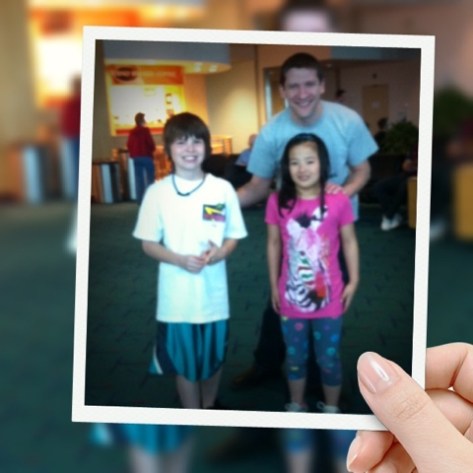
Reed, Jackson, and Abbie, I love you so very much, and I am deeply grateful to God for blessing my life with you. Also, thanks for putting up with my hair-brained idea to do this!!! The photo today is of you three…it was the last time I saw you (at the Portland airport on May 12).

I am even more blessed as I have some “bonus” family members coming along with my sweet little family: my parents, Dave & Becky, a niece from Iowa, Tess, and a nephew from Oregon, Connor. Tess and Connor graduated from high school last month, so we thought it was the perfect time for them to tag along to South Africa and Swaziland.

We will stay in Cape Town until Monday, and then we’ll travel north to Kruger Park for a safari. I have been dreaming about taking our kiddos on a safari since I experienced my first one, over six years ago now. I can’t wait to see the amazing animals through their eyes! To end our trip, we will go to Mhlosheni, Swaziland, to visit our sponsored children – all 12 of them across the 8 of us! This, too, has been a dream of mine since I first met our sponsored children.

After 40 days of great moments and lots of life lessons, amazing blessings are surely in store. Of course, all of our days – even those average and below average days – are blessings. But then there are those amazing, once-in-a-lifetime days that fill our sails and warm our hearts. My prayer is that I can appreciate all of the days God gives me, no matter what they hold. Still, I must say a big “THANK YOU!” to the man upstairs for carrying us all through the past 40 days apart.

So…as I am able to locate wifi, this blog will shift to a travelogue of our family adventures. Tune in (or out) as you please. Thanks for going along on the ride thus far…

20120621-090719.jpg

Good-bye girls…now global citizens

Our program here in Cape Town has not officially ended, but with one early departure, yesterday we had to say good-bye to our group of girls as we have come to know it. Kym will be leaving Thursday morning, so she finished up the requirements for the Global Psychology class Tuesday. The others will take their exam, etc. Thursday morning. All will wrap up their volunteer experiences by week’s end.

It’s hard to end such an experience…there is always much more to be said; much more to learn. We watched a wonderful film together (I will post some film recommendations tomorrow). We also had a few minutes to debrief and pray. I shared some of their “pre-trip” expectations, hopes, and fears that they had written about waaaay back on May 2. Thankfully, the only fear that was realized was buying too much stuff to lug home. 🙂

The hopes and expectations were fulfilled for the most part. It hasn’t been a perfect experience…I can tell there is a lingering desire to be in rural parts of Africa (i.e., as opposed to this modern urban environment). Perhaps that will happen in future trips, whether through volunteering, mission work, leisure travel, or even studying or working (or living!) abroad. Still, much was experienced…much was learned.

So, when these young women return home, be sure to ask them to tell you stories from their trip…to show you pictures and videos. We can’t really answer the commonly asked question, “How was your trip?” There is too much to say to have a simple response; stories must be told. You can ask this older woman too, for I also have learned a lot.

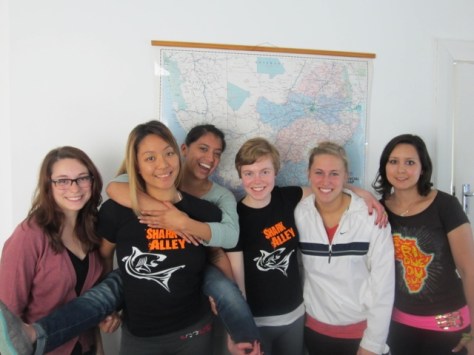
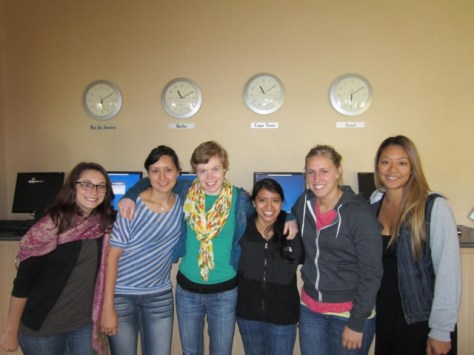
The only photos today are the before and after pictures of the group…I think they held up very well, and they even look like now they have become true global citizens!

20120620-134150.jpg

20120620-134205.jpg

"Cross quickly."

I don’t have a very big “report” to file today (though I will get my “preach” on below). Yesterday morning during class, I enjoyed the girls’ reports on shark-cage diving (yikes!, Kym & Kjersten) and cheetah petting (purrrr, Crystal & Jennifer). Courtney and Kelsey were off at Miracle Kidz (way to go holding those babies!). Yesterday afternoon, the girls took the train to Muizenberg/St. James to the beach to enjoy a nice “winter” day collecting seashells and soaking up some sun (& I’m sure doing some homework too). 😉

Today, the seven of us will gather to do a bit of debriefing, including discussing our time here of course, as well as completing some questionnaires (i.e., an evaluation of the program from our partner organization AIFS [the American Institute of Foreign Study], and some research surveys from me…they did baseline surveys before we left; I am interested in the impact of this type of experience on one’s level of ethnocentrism and views on meaning in life).

The only photos today are of two signs: (1) the crosswalk sign we’ve all become accustomed to here (with both Afrikaans & English) and (2) the street sign of Good Hope Studies on short and sweet Mariendahl Avenue Lane. I haven’t asked what’s up, but street signs have two types of categories with the name, such as both avenue and lane; oh yeah, and “weg” is short for some sort of street but I have no clue what. That’s all I’ve got to say on the street sign…I just thought it was a nice shot with the winter flowers in the background.

I have a bit more to say about the crosswalk sign, which cracks me up…here are its directions: “PRESS BUTTON – WAIT TILL TRAFFIC STOPS – CROSS QUICKLY.” I like the tip on waiting until the traffic stops (duh!), and I love how it makes no mention of the pedestrian light that is supposed to change from a little red person to a green one. Maybe that’s because that little green man is seen for only about 3 seconds before he goes away, hence the third directive, “cross quickly.” That third command should be accompanied by a jillion exclamation points for emphasis…or maybe ginormous lettering with red glittery paint and little white flashing lights (ok, point made; I will stop now…not weird, just different [see prior post by that title]).

I took the picture of the crosswalk sign on my walk to church Sunday morning, so I’ve been thinking about it a few days. “Cross quickly.” Yes, that is an important rule for crossing these Cape Town streets, as well as streets, avenues, lanes, and “wegs” (?) in most bustling cities around the world. Yes, I want my children to know that rule when there are cars on the road, a locomotive on the tracks, or crocodiles in the river.

However, that is the opposite of what I want my kids to know – what I want my students to know – what I want to know – about the people and experiences we encounter throughout our lives. Crossing quickly may result in missing out on what is waiting to be discovered, whether in a new (or old) relationship, an orange-red sunset, a warm cup of coffee, an honest conversation, a dish of creamy gelato, the laughter (or tears) of a friend, the magnificence of the ocean, the pain of another.

Crossing quickly works well in some circumstances; it even keeps us alive. But what if we cross through our lives more slowly, savoring the moments God gives us…appreciating the daily gifts all around us? For it is these moments that nourish our minds and nurture our souls. This, too, keeps us alive and truly living.

I am thankful we did not cross quickly during our walk through Langa Township last week. Today the students turned in reflection papers on that experience, so I know how deeply they were impacted by it. We did not cross quickly in the barracks-style apartments; we did not cross quickly in the shanty-town shacks. We did not cross quickly by the sangoma (the traditional healer), even though we kind of wanted to at the time.

By crossing slowly, we were able to better understand the circumstances and people of Langa Township. By crossing slowly we were able to show we are interested in them and care about them, despite being uncomfortable “touring” their homes (this was no street of dreams). By crossing slowly, I can tell you that each young woman was forever changed…

She will tell her friends and family about what she learned; she will show them pictures and share stories of Langa and its people. She will be spurred on to get involved in issues of social justice that touch her heart. She will not be complacent or say, “that’s too big of a problem; too much for me to tackle.” Instead, she will ask herself, “what can I do at this point in time for this one?”

Let’s cross slowly today…let’s find the meaning in each moment, and experience it as a gift. I think we’ll all have a better day – a better lifetime of days – if we do.

Proteas & earth pigs; Pinotage & springboks

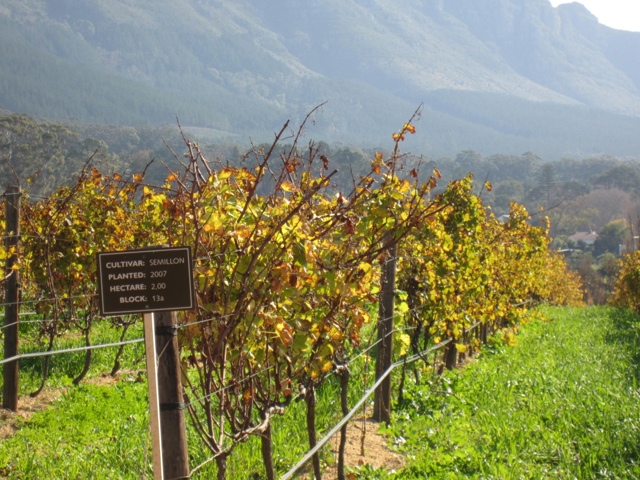
Saturday was a lovely, sunny day…I spent the morning reading, journaling, grading, and I feel prepared for the final week of class. In the afternoon, Sheila and I went to a local vineyard, Steenberg, which was founded in 1682 (!). The vineyards are absolutely beautiful now with the golden grape leaves of late autumn (see photo).

The wine tasting was free (!), and we learned a lot about local history through the wines, many of which were named after ships from the war at Muizenberg…the HMS Rattlesnake, Sphynx, and Echo, to name a few. It was a delightful way to spend a couple of hours. The sun was so warm, I even had to remove my outer sweater and then apply sunscreen (amazing!). I think a few freckles popped out.

The flower in the photo is a protea, the national flower of South Africa. It has a huge blossom, sort of reminiscent of a small pineapple, only pink…lovely, lovely. (I read how words are often said twice for emphasis in “African English”…seems fitting here.) You can see how large it is by using Sheila’s hand as a frame of reference. The grounds of this vineyard were quite stunning with the grapevines, flowers & trees (including wonderfully smelling eucalyptus), water features, and mountains in the background. (And the spectacular chandelier made of glass grapes!)

From my Lonely Planet travel guide book, “Dozens of flowers that are domesticated elsewhere grow wild here, including gladiolus, proteas, birds of paradise, and African lilies. South Africa is also the only country with one of the world’s six floral kingdoms within its borders.” I guess there are over 1300 species of plants in the Cape Floral Region, whereas the South American rainforests can only boast 900 species. Even more, “Over 20,000 plant species sprout from South African soil – an amazing 10% of the world’s total, although the country constitutes only 1% of the earth’s land surface.” Who knew? Based on those statistics, that must mean that there are over 200,000 plant species in the world…way to go, God! His Creation of plants, animals, land formations, bodies of water, and even us humans is pretty incredible. By the way, I also learned (again from my guide book) that “aardvark” is an Afrikaans word meaning “earth pig.” And, hoofed animals (like the aforementioned earth pig) are called “ungulates.” I think I knew that term once, but had forgotten it. (Sorry for the long paragraph with the biology lesson…I told you I spent Saturday morning reading!)

Saturday evening was another rugby match, but Binci was unable to join us (her absence was a bit mysterious…she just told Sheila she wasn’t coming). Anyway, this time the food was ostrich curry and noodles…very yum yum (see photo)…along with some Pinotage, a red wine unique to South Africa. Our Hermanus guide, Marinda (from last Sunday), told me that a horticulturist at the University of Stellenbosch created it by crossing Pinot and Cinsaut (or Shiraz, formerly called Hermitage) grapes, hence, Pinotage.

Don’t worry, I’m really not drinking all the time, it is just more a part of the culture here, in the biggest wine-producing region outside of Europe. And, it is done responsibly and in moderation (not to say there aren’t problems with alcohol abuse and dependence). At the vineyards, the standard six tastes are very small, probably not even equaling one glass. Here is an amusing quote, again from my guide book: “Today, praise be the Lord, wine was pressed for the first time from Cape grapes.” –Jan Van Riebeeck, 2 February 1659. There is a looooong history of wine here.

Oh, the Springboks won the rugby match against England, 36-27. I’ll spare you the bloodied faces in my photos this week. It was quite exciting, and it got very close in the second half after the Springboks dominated the first half. No “yum yum” comments this time from the gallery, though I think I have identified my favorite: #8, Pierre Spies (say “Spees”). I think I might have to buy a Springboks jersey or scarf…I have become a fan.

Sunday morning I returned to the Claremont Methodist Church…it was good to visit once again. This week the message was out of Ephesians 6:10-20, reminding us to put on God’s armor everyday to face the ongoing spiritual warfare in the world. We were urged to pray fervently, and never forget to carry God’s word, our sword, into battle. It was passionately preached, and I felt inspired. This little church in South Africa has a big heart, and I appreciate the warm welcome I received during my time here.

The evening held more rugby…this time the junior Springbok team – the “Baby Boks” – played Argentina in the Junior World Cup semifinals. These guys are are 18- to 20-year-olds and future “grown-up bok” stars. The Baby Boks easily won, 35-3, and will face New Zealand in the final Friday night. Even more, it will be held in Newlands Stadium, just down the street from my home stay.

On to our last week of the program…!

Geography lesson

Just a quick update on this Friday afternoon before I leave GHS’ wifi…I was successful in finding both a South Africa flag and map! Even better, the flag guy remembered me…I liked that so I didn’t even bother bargaining with him on the price (& it was only $6). And, I was sure to select a map that has “Mhlosheni” on it. That is the rural community in Swaziland that our church partners with (via World Vision), and where I was prior to my teaching gig in Cape Town (& where I’ll return later this month with my family).

Mhlosheni isn’t on most maps, so I was quite pleased to purchase one that has it. If you’re not aware of the geography of southern Africa, two small nations -Swaziland and Lesotho (say “Luh-soo-too”) – are on the same map with South Africa as they are nearly surrounded by it (actually, Lesotho is surrounded by SA, but Swaziland also shares a border with Mozambique). End of geography lesson…& my Friday afternoon report. Happy weekend everyone!

Super-host-mom, Sabine

Well, I finally got a quick pic of Sabine (say “Sa-bean-a”), the host mom of Courtney, Jennifer, Crystal, & Kym. As you’ll see, she has a twinkle in her eye and a warm smile…every time I’ve seen her she has shared her friendly expression. She often is zipping around in her little car, delivering girls here-and-there, including her own two young daughters. Courtney and I were walking from the school to the main shopping area yesterday when – *poof* – out of nowhere, there was Sabine, ready to take Courtney home. Perhaps she also has angels’ wings.

Today the students are at their practicum sites. I will do some grading and head in to the school for awhile. I’m also on a quest for a large wall-map of South Africa. We’ll see if I get lucky and find one. I may return to a street vendor I talked with a week or so ago and purchase a SA flag he has for R50 as well. I’m not sure what I’ll do with either a map or a flag, but they seem like good souvenirs of my time here. I had been to SA several times prior to this trip, but with such an extended stay this time around, I have learned much about this lovely country, and I think I would look fondly upon a map and flag of it (& they’re easy to pack!).

This is the last weekend before our program ends, so the girls are free to make plans to get in the remaining site-seeing they’d like to do. I have heard talk of seeing butterflies and sharks (though not concurrently), so I am already looking forward to hearing the stories on Monday. Tomorrow I will take in the rugby match with Sheila and Binci, and go along on whatever other local outings are planned.

By the way, my wifi hot spot at the mall didn’t work the last time I tried, so I’m not sure if I’ll be able to post again before Monday. If not, I’ll “talk” with you then…

P.S. Five days until I am reunited with my family…after 35 days apart, 5 sounds pretty awesome! Jackson & Abbie, I’ll see you very soon and give you the biggest hugs ever (you too, Reed)!

Angels, miracles, and soup

I finally have a couple of pictures of the “girls” with their home stay hosts. However, this is still an incomplete report as super-host-mom, Sabine, was not yet home when I took the one of Kym, Jen, Crystal, & Courtney. You will see them with Yul, Loren, & Tia…I will do my best to add a photo of Sabine if I see her again. Also, here are Kjersten & Kelsey are with their adorable hosts, Patrick (Patty) & Beryl. When we asked for the photo, Beryl exclaimed, “Oh Erin, you should’ve let me know so I could’ve had my hair done!” 🙂 These hosts have been fabulous to our girls…we are grateful to GHS and their good care of us.

Wednesday was another day of practicum experiences. This week I went to Little Angels on Owl Place (such cute names). This is a day care center for children of single mothers. Today there were six little angels there (one was already napping and isn’t in the photo), as well as three “big angels” in Kjersten, Kelsey, and Jolene, the amazing woman who takes care of these wee ones each and every day. She does a wonderful job of establishing a routine for the crawlers and toddlers, and I saw a lot of evidence of healthy developmental strategies. It is a brightly colored, stimulating place where nourishing food, good naps, and lots of fun are present. The photos show this well through the healthy faces…the sweet nappers are Lolli with Kelsey and Devotion with Kjersten.

Next I went to Miracle Kidz, which is a new site at which several of the girls have already volunteered, and I think they all will during the remaining time here. The super-host-mom, Sabine, facilitated this opportunity for supplemental practicum experiences. It is a safe house for babies and children who have had a rough start in life. They can live at Miracle Kidz up to a year, at which time they would transition to foster care. I couldn’t take photos of the children, and Elsie, the woman in charge, was at the doctor with some of the kids, so the only photo is of Crystal and Courtney by the sign. In my short time there, I could easily tell that it is a very special place with people doing incredibly important work there…facilitating miracles.

I spent the afternoon helping at a soup kitchen in Cape Flats, specifically Mitchell’s Plain, a low-lying part of Cape Town that was a racially segregated area during apartheid. It was one of the areas people were forced into when they were removed from District Six. This soup kitchen was established in 2009 by the son of Stanford, our kind GHS driver (he was in the photo of the girls in front of the van at the airport back on May 27).

Tragically, this eldest son of Stanford – Quinton, age 45 – was killed in 2010, right in the neighborhood where the soup kitchen operates. The family has kept the kitchen going…just barely. They can only afford to feed the community once per week. Either Stanford’s wife, Lillian, or daughter-in-law (i.e., Quinton’s widow) make 100 liters of soup each Wednesday. Adults get 3 ladles (along with 2 slices of bread) and children get 2 ladles (plus 1 piece of bread). Stanford said he’s sure Quinton smiles down from heaven every Wednesday afternoon.

This was a very touching experience, reminiscent of the mealie meal I have dished out in Swazi preschools. The people are so grateful for the small portion they are given, and then the kids just want to play. 🙂 This was the majority of our time spent – holding kids, dancing, playing street games, taking pictures. They were hungry for our affections, as well as the soup. I believe it was just as nourishing for me as it was for them.

My students were at their practicum sites, but I was accompanied by seven other Good Hope students to the soup kitchen. They are all here learning English (as that is the function of GHS), and were a bit puzzled by why I am here. The composition of our group was as follows: two guys from Switzerland, one guy from Spain, one girl from Angola, one girl from Sweden, one girl from Colombia, one girl from Brazil, and me. The girl from Angola said my accent is like that of a movie star. On the drive home, we shared tongue twisters in our native languages. They REALLY liked my “she sells sea shells by the sea shore” bit…they roared with laughter as they attempted to say it. 🙂 It was a fun afternoon together, serving in this truly global community…I’m so glad I went.

Test & Township Tuesday

Tuesday started with our second test in Global Psychology. You can see the students writing away in the first photo (along with our new classroom at GHS, and Rosie the GHS cat in another photo). This test covered topics such as indigenous psychologies (i.e., understanding people in a cultural and global context), alternative psychologies (e.g., liberation psychology of Latin America), qualitative research methods for a global psychology, and psychotherapy within a cultural/global context (being a clinical psychologist, this was my favorite topic and I rambled on quite awhile).

After a break, we launched into the final segment of our “term” and then worked on a group project for awhile. They are working in pairs to investigate websites of organizations with a global focus (Crystal & Kjersten are reviewing Pathways to Peace and Kym and Jen are looking at One). On our last day of class, they will make brief presentations on what they learned, including a recommendation for how the organization could improve its impact based on things we’ve discussed in class. Also, they will write individual reflection papers on the experience. It’s hard to believe we are just over a week away from our last class (i.e., next Thursday).

Rashied collected us at half past one and took us on our long-awaited township tour. We drove to Langa Township, where around 350,000 people reside, and there is a 42% unemployment rate. This area existed as a work camp before Apartheid; men would go to work there and live in crowded “hostels.” Then it was used to segregate blacks during Apartheid. We first stopped at a community center, where we met our local guide, a woman my age named Mpumie (say “Poomie”). She took us through the center, and we saw a pottery project where the proceeds benefit the community. Children can come here to learn crafts and other trades for possible future employment. Very practical.

We began our walking tour with Mpumie on this cloudy and chilly afternoon…we were quite the spectacle walking down the streets, often drawing looks, waves, and smiles from the children who were walking home from school. We learned that the people of Langa live in one of three “classes” (i.e., low, middle, and upper [referred to as Beverly Hills]) and corresponding types of homes with various levels of government ownership and subsidies. Before we went into the homes, we were educated on the delicacy of sheep heads and got to see a bit of the cleaning and de-braining process (gulp). I was very thankful we weren’t offered a sample.

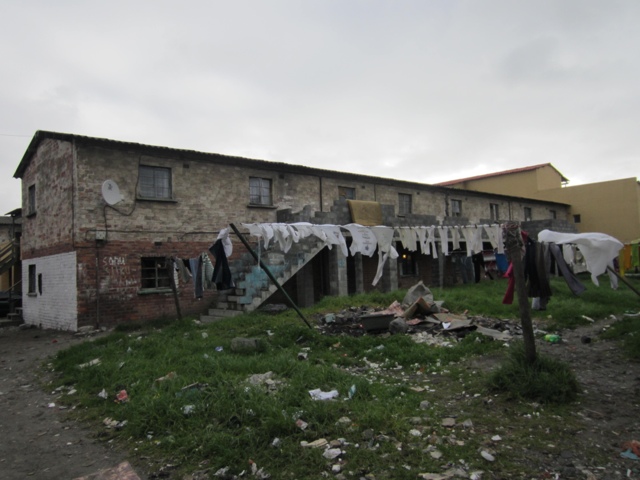
The low class residents live in the old hostels, which were pretty challenging to behold. Inside these run-down concrete structures, 16 families live in each unit. Two or three families share each bedroom, and there is a communal dining room (see photo of the concrete table) that doubles as a sleeping area for children over age 8. Mpumie talked a lot about how children engage in sexual behaviors at very early ages due to what they see in these living conditions. This contributes to high rates of teen pregnancies and HIV/AIDS, among other things. These hostels were dark, cold, and depressing, though Mpumie reminded us that they have running (cold) water and flush toilets, so they are better than living in the rural villages.

The middle class homes are better, of course, though still very small and simple. Some were in better shape than others. Teachers might live in such accommodations. The upper class homes are nicer, yet understated by our American standards. Mpumie said that doctors, lawyers, and nurses live in these types of homes. They stay in the area because it is where they are from…Langa is their community.

We continued to walk on and got to the shanty part of the township. I was prepared for what we would see, as Reed and I toured a shanty in Soweto, a segregated part of Johannesbug, about six years ago. Shanty towns are where the structures are made out of whatever materials can be gathered…wood, corrugated tin, cardboard, etc. I guess it is a lower class than the low class hostels, as there is not running water or flush toilets in the homes. Again, it was hard to behold these living conditions. However, Mpumie said she chooses to live here over the hostels due to the less crowded living quarters. She moved from the hostels with the birth of her first child, nearly 20 years ago. Wow.

She told us about how rain water runs through the homes, as does the wind of course. People were standing around open fires outside for warmth, and she said that the fires are brought indoors this time of year, and often the structures catch fire and are quickly consumed (& firetrucks can’t access them). Mpumie also spoke of their “friends,” the rats. She proudly noted the row of clean toilet facilities (i.e., like our honey buckets/port-a-potties) and water taps around the shanty town. There was also a community gathering place where you can catch up on all the latest gossip. Some things are universal, aren’t they? 🙂

We had one more stop in Langa: to the “Sangoma,” or local healer. A sort of medicine man, he is the one people turn to in times of sickness, possession of evil spirits, and romance problems. We all entered his dark, strangely smelling cargo container (what most of the small business use for a structure). I saw our guide slip him some cash, at least 100 Rands. We sat and listened to him tell us tales of his ancestors, snake oils, and potions. I felt skeptical as I saw the many empty vodka, gin, and whiskey bottles, but at the same time I believed in his importance to the local people. He clearly is someone they turn to for hope and healing amidst the suffering and despair.

When we got back into the familiar and comfortable setting of Rashied’s van, a few comments and observations were voiced. Jen thought her brother would have loved the animal bones and snake skins hanging from the ceiling. Kelsey offered to share with us her good karma as the Sangoma had just whisked away any lurking evil spirits from her with his buffalo- and cow-tail hand brooms. Courtney honestly exclaimed, “I could have lived my whole life never having done that.” 🙂

The next part of our tour was a drive through the Guguletu Township; a nearby community of around 280,000 colored people. Remember that this term is not used as we do, with a negative connotation, but rather to describe those who are neither black nor white. Many Muslim families reside in this township, which looks to be more of a middle- and low-class blend, though not quite as impoverished as the hostels and shanty towns of Langa. Rashied said it is where the Langa people would go if they could afford a dinner out with friends.

As Rashied delivered us home to our suburban residences, we had much to think about…I learned a lot from Mpumie about choices, priorities, and quality of life. I saw a lot of entrepreneurial and creative spirits surviving in living conditions that would probably do me in. I observed a lot of people living with a lot of disadvantages. I think of them now as I type this on my iPad, in a lighted comfortable (albeit chilly) home, my belly full from a warm dinner of vegetables and meat, almost ready to brush my teeth and go to sleep in my private quarters (under five blankets).

Why do I complain about doing laundry, vacuuming, or getting groceries? Why do I moan about traffic-jams and busy-ness? Why would I ever not want to go to work? Why does not having Internet at my home stay frustrate me? Why does my routine get me down sometimes? Why do I reach for my water bottle with the slightest thirst? Why am I grumpy if I don’t find a good parking spot? Why do I whine about ANYthing? I am blessed far beyond I deserve…far more than most of the people in the world.

May this time in Langa today – just as my time in the countryside of Swaziland last month and again in a couple of weeks – cause me to be ever mindful of what I have been given. Much is asked of me; of us. May we not be idle but be active participants in our global community. May we see a need and meet a need each and every day. May we continue to ask, what can I do at this point in time for this one?
Not "weird" but "different"

While living in South Africa, we have caught ourselves describing something new we’ve observed or experienced and referring to it as “weird”…we quickly catch ourselves and switch out weird for “different.” I thought I’d reflect a bit on this in today’s post, since I don’t have any exciting news to report or sites to describe. Students, please feel free to reply and post other differences you’ve noticed.

First, a few differences related to race…
For instance, isn’t it weird, I mean different, how many Afrikaaner (white) families have black maids? Isn’t it different how the term “colored” is not derogatory here, but rather descriptive of those who are neither white nor black? Isn’t it different to perceive racial tensions in the air, even though we are 18 years removed from the official end of apartheid? These differences cause discomfort at times.

Second, a few differences we like…
There are very few SUVs on the roads (now that is weird!). People here drive itty bitty, manual transmission cars for the most part. Generally speaking, people seem more conscientious about conserving resources, whether it is petrol (R11+ per liter…have fun converting to $ per gallon), water, or electricity (homes are not heated!). We like the multiple languages we hear every day, as well as the diversity of people that surrounds us. We like how inexpensive things are, for the most part anyway. We like how kids wear uniforms to school. We like the dinners our hosts make us each night…yum.

Third, a few differences we don’t like so much…
Pedestrians are not valued very highly here! Those itty bitty cars race down the streets, and I have yet to see one yield to a pedestrian…even in a crosswalk (I kid you not). The sidewalks are often in poor condition with quite a bit of trash alongside (despite the frequently placed green “zibi bins”). The only photo today is of the sidewalk that I walk down every day…there has been a huge hole in it the past three weeks. Today I was glad to see someone barricaded it off with some big rocks and wrote “please fix my hood” next to it. I feel safer already. 🙂 We are not crazy about the minibus taxi drivers that yell, whistle, and honk (or hoot, see below) to see if you want a ride…they get annoying when you’re waiting FOREVER to cross a street.

Fourth, some different terms we’ve learned…
Nappy = diaper
Cot = crib
Pram = stroller
Bonnet = car hood
Hooter = car horn (we did convey what we usually refer to when we talk about hooters)
Robot = traffic/stoplight
Geiser = hot water heater
Esh = kind of like “good grief”
Comfort stop = potty/snack break on a road trip…we like that one
Toilet = restroom/bathroom…easy translation but we don’t like asking for the “toilet”

I’m certain there are many other differences yet to describe, but this is a start. Jen, Kym, Kelsey, Courtney, Crystal, and Kjersten can share more…

Penguins, dassies, baboons, & whales (oh my!)

Our Sunday excursion to Hermanus was nice…we were so thankful for the return of sunny, warm skies. We drove along the coastal route on our way, first stopping for a photo op at Gordon’s Bay (a gruesome shark attack occurred here about three months ago…Kelsey & Kjersten can tell you all about it [from a 2-hour dinner conversation with their hosts]).

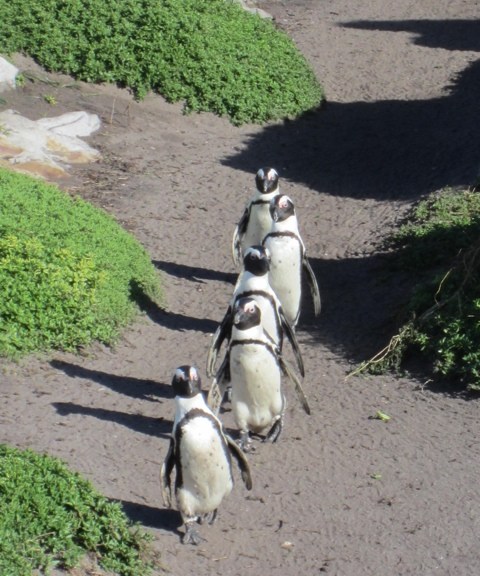
Next we went to Betty’s Bay, home of the Stony Point penguin colony. We saw a lot more penguins than we did at Simon’s Town, so it was a great experience (though more penguins = more stink). And, we learned that they are called “jackass” penguins due to the braying sound they make when they mate and mark their territory. However, most other kinds of penguins make the same sound, so they are usually called African penguins. 🙂

We also saw several dassies, which are cute, furry brown animals, kind of like big bunnies without the long ears. They look like the kind of animal you want to pick up and cuddle (though this describes pretty much all the animals these girls see!), but our guide, Marinda, said they often carry rabies and are “eagle food.” 😦 ,

On a side note…we learned a new term today: “bunny hugger” which basically is an animal lover (this describes our group well). Sometime I will have to post interesting terms for objects/phrases we’ve learned. Anyway, also at Stony Point, there was an old shipwreck in the bay…I thought it was pretty cool.

Next we motored on down the road and encountered some baboons. There was a small group of various sizes, including adorable babies and the big “king” baboon. Our guide told us how when the young adult males try to vie for the position of “king,” they sometimes grab baby baboons by the head and rip them apart to show their dominance. Sounds pretty nasty.

Then we drove a bit more to Hermanus, the best land-based whale-watching spot in the world. Well, this day the whales were kinda hard to spot…we saw some from a distance, but no spectacular sightings, I’m sorry to say. However, we may be tempted to tell a “fish tale” (yes, we know whales are not fish) about midwife whales coming alongside a mother in labor and helping push out the baby whale (which was then named “Concordia Pacific” in honor of our students from CU and Warner Pacific). 😉 Even the “whale crier of Hermanus” with his hooter (another term that makes us giggle, this time meaning horn), couldn’t help us much.

We enjoyed lunch and gelato together, the beautiful views, and the warm sun on our faces. We also drove to a mountain-top lookout for another great view. Basically, it was a day of a lot of great scenic views just asking for fun photos to be taken. I have included many here…hope you enjoy.

Back to the books Monday…half way done!